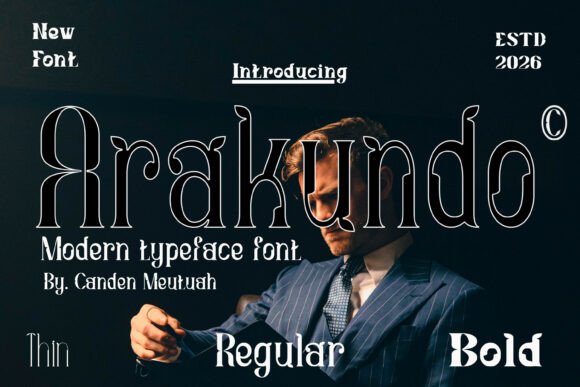
Arakundo Display Typeface for Bold Brand Identity Projects
I was staring at a blank artboard, coffee cold on the desk, trying to solve a visual identity problem that felt bigger than just picking a typeface. The client wanted something that screamed confidence but whispered elegance—a difficult balance for any display font. That’s when I pulled up Arakundo. It wasn’t just another asset in my library; it felt like the missing piece of a puzzle I hadn’t realized was incomplete. As a graphic designer who spends half their life tweaking kerning pairs and the other half arguing with clients about color theory, finding a font that bridges the gap between bold statement-making and typographic harmony is rare. Arakundo is stylish, bold, and beautiful, offering exactly that kind of harmony for a variety of design projects.
Arakundo for Logos and Branding Visual Identity
When you start a branding project, the logo is usually where the tension lives. You need something legible at favicon size but impactful on a storefront sign. Testing Arakundo for this purpose revealed its true strength: it doesn’t shout so loudly that it loses detail, nor does it whisper so softly that it gets lost in noise. In my recent mockup phase, I placed the wordmark on a minimalist business card layout, and the weight distribution was instantly pleasing. This is not a generic sans serif or a overly ornate script; it is a distinct display typeface that commands attention while maintaining professional restraint. For entrepreneurs looking to establish immediate recognition, using Arakundo as the primary logotype provides a sturdy foundation for a brand identity that feels both modern and timeless.
The character shapes have a unique geometric yet organic feel that prevents the brand from looking too corporate or too playful. It sits right in that sweet spot for boutique businesses, creative studios, and lifestyle brands. When I tested it alongside simple iconography, the negative space worked perfectly, allowing the logo to breathe. This makes Arakundo an excellent choice for designers who need a versatile anchor for their logos and branding efforts without spending weeks customizing letterforms from scratch.
Arakundo for Social Media Posts and Digital Engagement
Digital platforms are a different beast entirely. On Instagram or LinkedIn, your content has milliseconds to grab attention before the user scrolls past. I took Arakundo into my social media templates to see how it performed in high-volume environments. The results were striking. Because it is a bold display font, it cuts through the clutter of busy feeds. I created a series of quote graphics and promotional banners, and the text remained crisp and readable even at smaller sizes on mobile devices.
For marketers and content creators, consistency is key to building a following. Using Arakundo across all digital touchpoints—from story highlights to pinned posts—creates a cohesive visual language. It adds a layer of sophistication that standard system fonts lack. I noticed that engagement seemed higher on posts where the headline utilized Arakundo compared to those using more common headings. It’s not magic; it’s psychology. People respond to typography that feels intentional. By integrating Arakundo into your social media posts, you signal that your brand pays attention to detail, which subtly builds trust with your audience.
Arakundo for Advertisements and Print Marketing Materials
While digital is crucial, print still holds immense power in physical marketing. I decided to test Arakundo on a set of A5 flyers and product packaging labels. The ink coverage and stroke contrast held up beautifully in print. There is a certain tactile quality to the way these letters sit on paper, especially when used for headlines. For advertisements, whether it’s a newspaper insert or a direct mailer, you need type that stops the eye. Arakundo delivers that impact immediately.
I paired it with a clean, minimal background to let the typography stand alone as the hero element. The beautiful typographic harmony mentioned in its description isn’t just hype; it refers to how the weights interact with each other. You can mix the boldest weights for main headlines with lighter iterations for subheads (if available in your specific file set) to create a clear visual hierarchy. This makes Arakundo incredibly practical for advertisements where you need to guide the viewer’s eye from the hook to the call-to-action efficiently. It works equally well on high-gloss brochure paper or matte packaging stock.
Font Pairing Strategies with Arakundo
One of the biggest mistakes designers make is letting a display font do all the heavy lifting. Arakundo is strong enough to stand alone, but for body text or longer descriptions, you need a reliable partner. In my workflow, I found that pairing Arakundo with a neutral sans serif font creates a perfect balance. The contrast between the expressive, bold nature of Arakundo and the functional clarity of a simple sans serif allows for readability without sacrificing style.
Alternatively, for more editorial or luxury projects, a classic serif font can complement the modern edge of Arakundo beautifully. Think of it as mixing a tailored suit with a sharp tie—the two elements enhance each other rather than competing. When designing editorial design layouts or website headers, this combination ensures that the brand feels established and trustworthy. Always remember to check the included styles and alternates in your font files to ensure you have enough variation to maintain interest throughout long documents.
Practical Tips for Testing Before Purchase
Before committing to a commercial license, I always recommend testing the font in real-world scenarios. Don’t just look at a specimen sheet. Create a mockup of the exact project you have in mind. If you are designing for a skincare brand, put the font on a jar label. If you are working on a tech startup, put it on a landing page hero section. This helps you assess readability, scalability, and overall mood alignment.
- Check Multilingual Support: Ensure the font supports the languages you need for your global audience.
- Review File Formats: Verify that you receive web-safe formats (WOFF/WOFF2) if you plan to use it on websites, alongside desktop formats (OTF/TTF).
- Analyze Weights: Make sure the range of weights meets your needs for creating hierarchy.
Arakundo proved itself to be more than just a pretty face. It is a functional, powerful tool for any designer serious about elevating their work. Whether you are crafting a full brand identity from scratch or looking to refresh an existing visual system, this display font offers the versatility and aesthetic appeal needed to succeed. It transforms ordinary layouts into compelling visual stories, making it a worthy addition to any professional’s toolkit.